

Replication Control Panel
The administration perspective in the CMS contains a control panel for replication. Here, for the single replication target (brXM 14.x or 15.1.x) or for each replication target (brXM 15.1.0 or later), you can monitor the status of the replication process, view error messages, pause and resume replication, and initiate a full or partial sync.
When you select a specific replication target in the target dropdown (brXM 15.1.0 or later), the page shows the current status and error messages of the selected target and allows operations on it. Operations on a target are performed independently from other target(s) in case you have multiple replication targets.
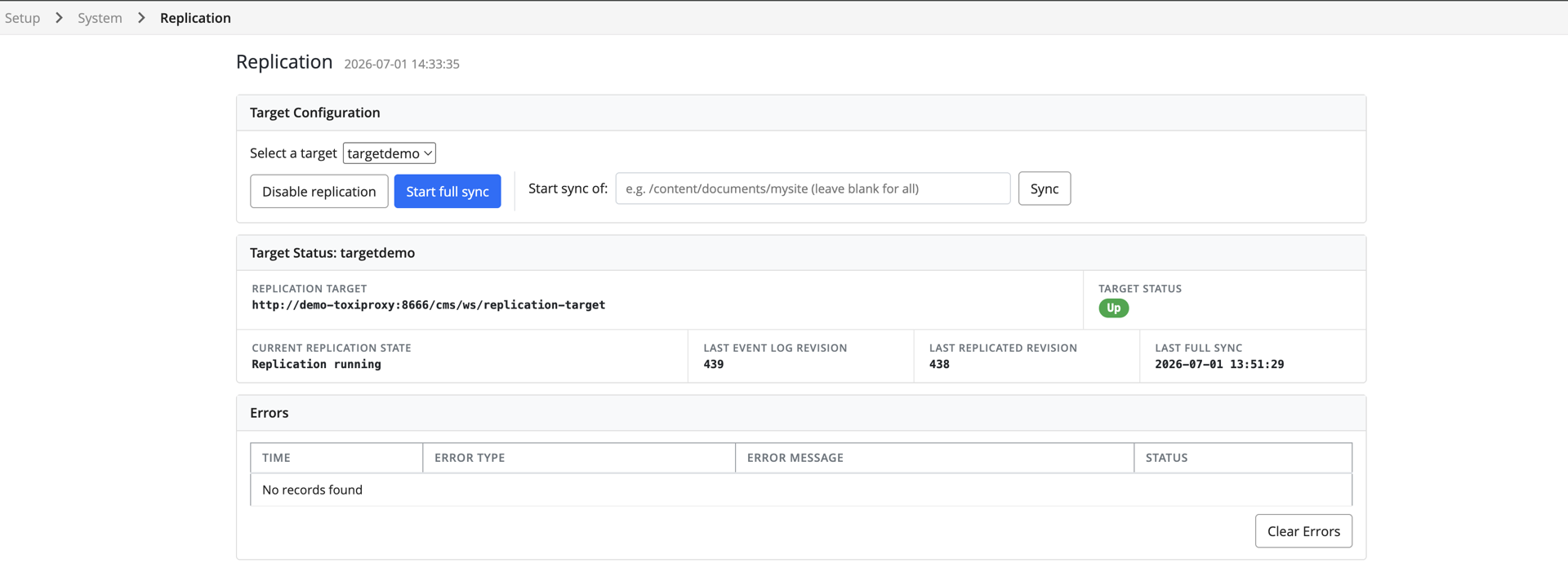
Initiating a full sync
When you first deploy your project, the target(s) must be brought in sync with the source. The amount of time this takes depends heavily on the amount of data to be transferred. During a sync, regular replication processing based on changes to the repository is suspended. After the sync has completed, regular replication processing is resumed and the backlog of changes built up in the meantime is processed.
Running a partial sync
When for whatever reason it happens that some document or folder in the target becomes out of sync with the source you can always run a partial sync on that document or folder to bring it back in sync. Under normal circumstances this should never occur though. Enter the path to the node to be re-synced and click the button to initiate the partial sync. As in the case of a full sync, this will also suspend regular replication processing until the partial sync has completed.
Pausing/resuming replication
When you bring the target down for maintenance, or you have not yet set up your target, you may want to suspend the replication process for the time being, although in the former case this is not strictly necessary. The replication process monitors the status of the target and recovers from occurrences where it is down or unreachable. After the target has been brought up you can enable the replication process again. Replication will process the backlog of changes to be brought in sync automatically.
Monitoring error messages
When the source cannot reach the target due to the target being down or because of a severed network connection, error messages will be shown indicating the problem. Other error conditions are also reported in this way and may be monitored by an administrator. Each error is shown with a suggested next action based on the type of failure - for example, whether it originated while packaging changes, syncing a subtree, or sending a package to the target - along with the underlying stack trace and message where available.
 The replication engine can recover from some error conditions automatically. A successful recovery is indicated by flagging the error as resolved; an error currently being retried automatically is flagged as such so it can be distinguished from one that requires attention. The replication engine currently knows how to automatically recover from two conditions:
- An ancestor of a unit of replication is reported missing on the target.In this case, a partial sync rooted at the missing ancestor is automatically scheduled.
- A sync root could not be applied on the target. In this case, the sync is automatically retried up to three times before it is flagged as requiring manual attention.
All other error conditions require an administrator to investigate and, where appropriate, initiate a partial or full sync to resolve them.
Futher details for support can be provided by clicking the details button, this will show what exactly went wrong to help diagnose the issue.
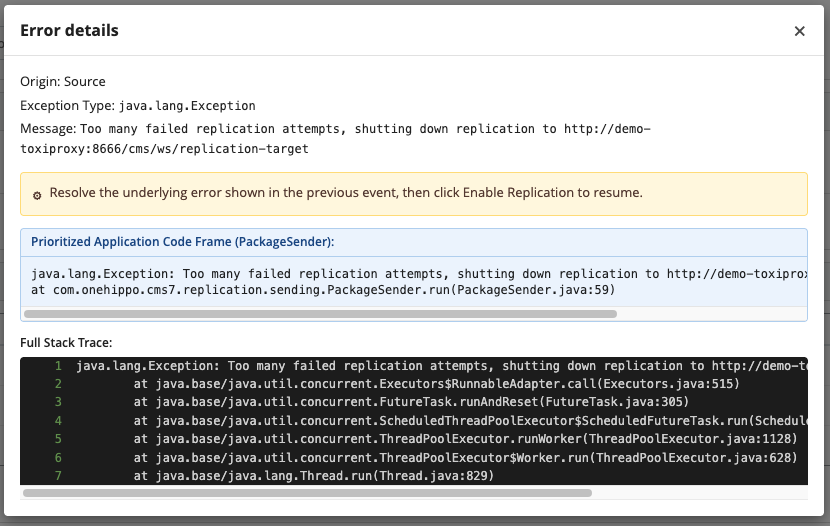
This error occurs when the same package has failed three times for the same reason. At that point, we consider the issue permanent and assume it requires resolution. Review the error message immediately preceding this occurrence to identify the cause.
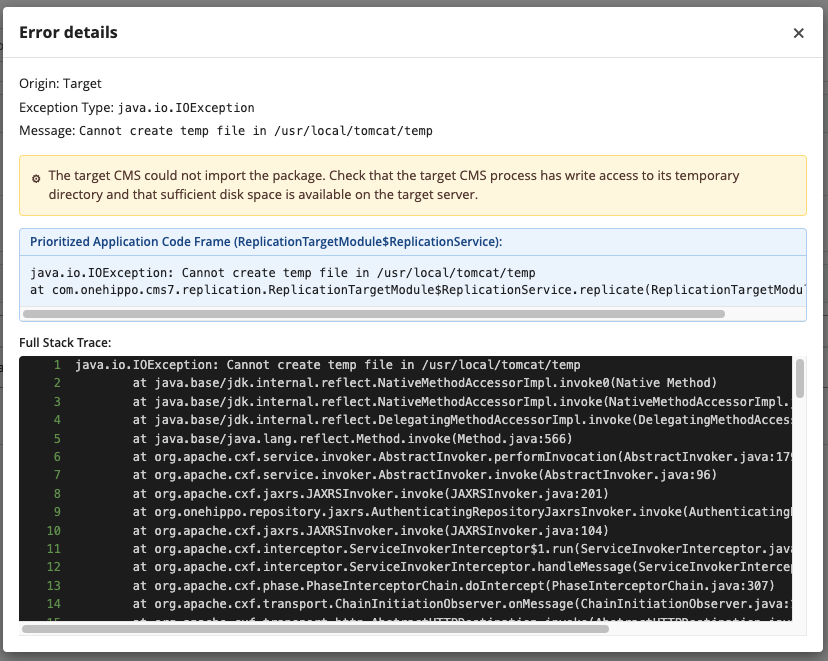
In this case, the permanent error was caused by the target server lacking permission to write to its temporary directory. To resolve the issue, grant write access to that directory for the user or process under which the server is running.